
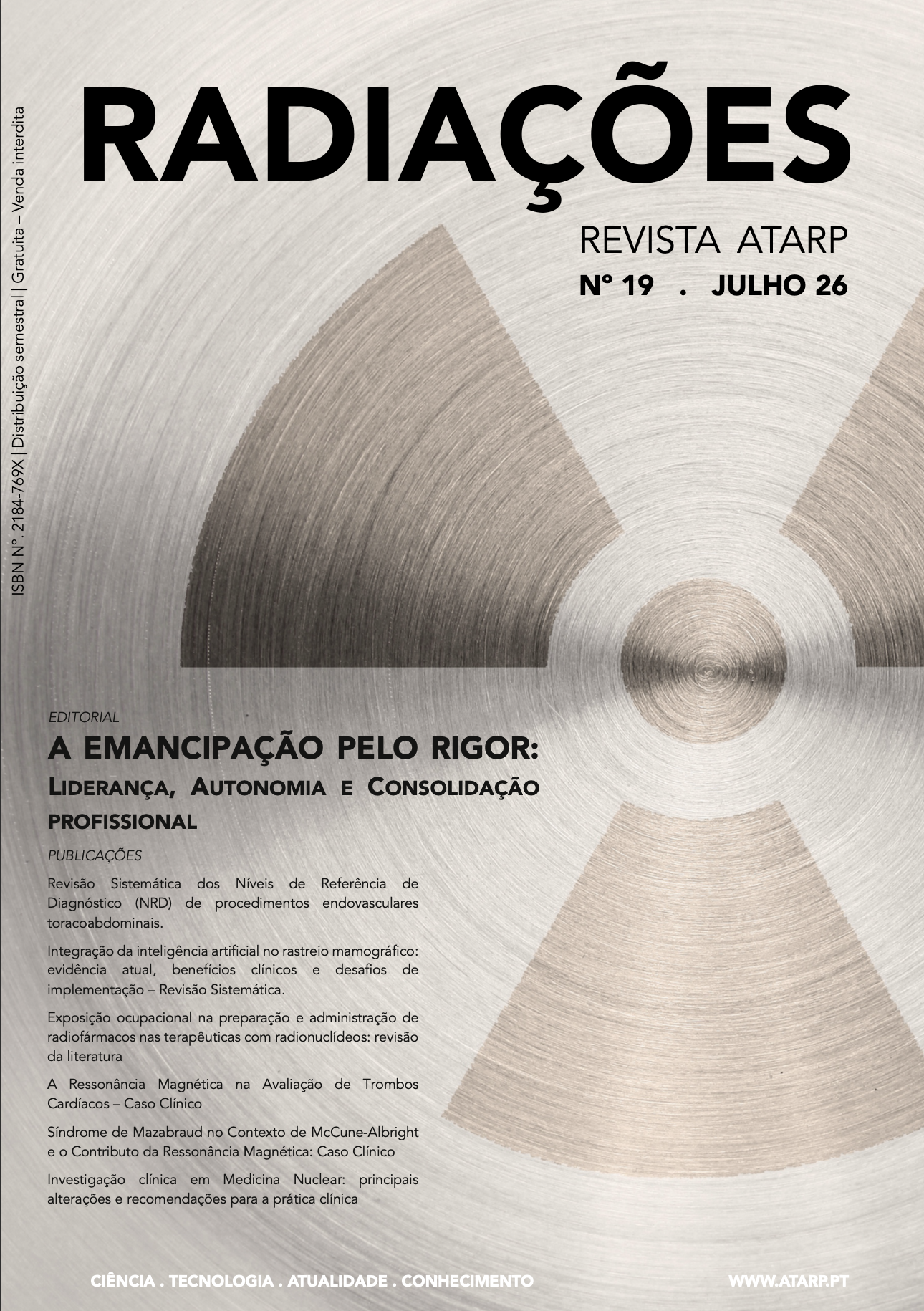
Emancipation through rigour: Leadership, Autonomy and Professional Development
DOI:
https://doi.org/10.83356/2026.rr.n19.33Keywords:
Leadership, Autonomy, Evidence-based practice, ResearchAbstract
Dear reader,
In the last two issues of RADIAÇÕES Journal, we have invited our community to engage in a profound, progressive and formative reflection. We began by examining scientific research as the irreplaceable foundation of our professional identity and, in the last issue, we advocated for clinical evidence as the compass that must guide our daily practice with pinpoint accuracy. Having mapped out this cohesive path — which links the essence of research to the complex clinical ecosystem — it is now imperative to take the decisive step that crowns this process of identity-building. The time has come to discuss, without reservation, the autonomy and leadership of Radiology, Radiotherapy and Nuclear Medicine Technicians.
The transition from a professional identity that has historically been technical and operational to one characterised by scientific leadership and clinical governance is an unavoidable contemporary imperative. As extensively documented in the literature on Evidence-Based Practice (EBP), the integration of scientific knowledge into the routine of healthcare services is not merely aimed at procedural effectiveness, but rather at achieving autonomy in complex decision-making (1,2). For professionals in our fields, this rigour is the driving force that radically transforms daily practice: we are no longer confined to operating state-of-the-art technological equipment, but actively lead the optimisation of diagnostic and therapeutic processes. Whilst science confers authority upon us, evidence gives us a voice.
This leadership we are referring to is entirely independent of formal positions, political appointments or rigid bureaucratic hierarchies. It is, however, a form of clinical and transformational leadership, defined in the healthcare literature as the ability to influence the continuous improvement of care, patient safety and institutional culture through shared knowledge (3). In Computed Tomography (CT) scan rooms, in linear accelerator bunkers or in radiopharmacy laboratories, the professional who questions established protocols in the light of the most recent literature, who advocates the personalisation of radiation doses (in accordance with the ALARA principle) and who manages risk is not merely applying or replicating a technical standard — they are exercising leadership and taking responsibility for quality and safety in healthcare.
Recent international studies on continuing professional development in the professions of radiography technician, radiotherapy technician and nuclear medicine technician reinforce the view that autonomy and interprofessional recognition are not simply granted to us by legislative acts. On the contrary, the evidence suggests that the expansion of the scope of practice and clinical autonomy depend directly on the scientific proactivity and leadership demonstrated by the profession itself within complex healthcare settings (4–8). The Advanced Practice models already documented in other countries — which now encompass responsibility for the interpretation and preliminary reporting of various medical imaging modalities, or the autonomous management and triage of acute toxicity in cancer patients undergoing radiotherapy — demonstrate that the advancement of our professions is intrinsically linked to robust leadership skills in applied research and clinical audit (9–11). When professionals adopt this proactive approach, they cease to be mere intermediaries and come to be recognised as indispensable and autonomous peers within multidisciplinary teams.
And our window of opportunity is happening today… we cannot wait for tomorrow. Today, we are facing one of the greatest windows of opportunity and disruption in our history: the widespread integration of Artificial Intelligence (AI) systems into diagnosis and treatment. Recent literature warns that professionals who position themselves merely as technical operators run the risk of becoming obsolete; conversely, those who take the lead in clinical validation, quality assurance and the ethical oversight of these new digital tools will be the architects of the future of healthcare (12–15).
We have the opportunity to write our own story, and we can do so by emphasising in every line the importance of our professions in increasingly complex healthcare settings. We will not achieve this by decree… we will achieve it by grounding our professions – but above all our professional attitude – in scientific research that promotes evidence-based practice, guiding increasingly safe and specialised care that will give us a voice within multidisciplinary teams.
We invite you to read these pages not merely as an observer of the evolution of our professions, but as the true protagonist – independent and rigorous – of the change that our professions demand.
We hope you find this an excellent and inspiring read.
The Editor-in-Chief
Rui Miguel Pereira
References
Sackett DL, Rosenberg WMC, Gray JAM, Haynes RB, Richardson WS. Evidence based medicine: what it is and what it isn’t. BMJ. 13 de Janeiro de 1996;312(7023):71–2. doi:10.1136/BMJ.312.7023.71 PubMed PMID: 8555924.
Straus SE., Glasziou Paul, Richardson WScott, Haynes RBrian. Evidence-based medicine: how to practice and teach EBM. 2019;324.
Aiken LH, Sermeus W, Van Den Heede K, Sloane DM, Busse R, McKee M, et al. Patient safety, satisfaction, and quality of hospital care: cross sectional surveys of nurses and patients in 12 countries in Europe and the United States. BMJ. 20 de Março de 2012;344(7851). doi:10.1136/BMJ.E1717 PubMed PMID: 22434089.
Hapi J, Yang Y, Akudjedu TN. Towards defining the competencies and leadership attributes for radiographer-led management in clinical practice: A scoping review. Radiography. 1 de Julho de 2025;31(4):102969. doi:10.1016/J.RADI.2025.102969 PubMed PMID: 40381267.
Rye M. Strengthening medical radiation technologist recognition through advanced practice in Canada: A narrative review. J Med Imaging Radiat Sci. 1 de Setembro de 2022;53(3):498–504. doi:10.1016/J.JMIR.2022.04.001 PubMed PMID: 35450808.
Oliveira C, Barbosa B, Couto JG, Bravo I, Khine R, McNair H. Advanced practice roles of therapeutic radiographers/radiation therapists: A systematic literature review. Radiography (Lond). 1 de Agosto de 2022;28(3):605–19. doi:10.1016/J.RADI.2022.04.009 PubMed PMID: 35550932.
Caulfield L. A literature review exploring the perceived impact, challenges and barriers of advanced and consultant practice in therapeutic radiography. Radiography. 1 de Agosto de 2021;27(3):950–5. doi:10.1016/j.radi.2021.01.002 PubMed PMID: 33536150.
EFRS. RERP - Radiographer Education, Research, and Practice: 2021–2031 [Internet]. 2021 [citado 21 de Julho de 2026]. Disponível em: www.efrs.eu
Hudson D. Reflections on leadership in advanced and consultant radiographic practice within the UK. J Med Imaging Radiat Sci. 1 de Junho de 2021;52(2):164–71. doi:10.1016/J.JMIR.2021.02.003 PubMed PMID: 33648876.
Yakubu A, Briggs E, Hacking S, Akudjedu TN. Clinical audit and research in radiography practice: An exploration of the English landscape. Radiography (Lond). 1 de Janeiro de 2023;29(1):200–6. doi:10.1016/J.RADI.2022.11.004 PubMed PMID: 36481787.
Watts H, Snaith B. Evidence based practice, research and the diagnostic radiographer role. An exploration of engagement, expectations and attitudes at a single centre. Radiography (Lond). 1 de Janeiro de 2023;29(1):124–30. doi:10.1016/J.RADI.2022.10.014 PubMed PMID: 36351305.
van de Venter R, Skelton E, Matthew J, Woznitza N, Tarroni G, Hirani SP, et al. Artificial intelligence education for radiographers, an evaluation of a UK postgraduate educational intervention using participatory action research: a pilot study. Insights Imaging. 1 de Dezembro de 2023;14(1). doi:10.1186/S13244-023-01372-2 PubMed PMID: 36735172.
Lewis SJ, Gandomkar Z, Brennan PC. Artificial Intelligence in medical imaging practice: looking to the future. J Med Radiat Sci. 1 de Dezembro de 2019;66(4):292–5. doi:10.1002/JMRS.369 PubMed PMID: 31709775.
Malamateniou C, McFadden S, McQuinlan Y, England A, Woznitza N, Goldsworthy S, et al. Artificial Intelligence: Guidance for clinical imaging and therapeutic radiography professionals, a summary by the Society of Radiographers AI working group. Radiography. 1 de Novembro de 2021;27(4):1192–202. doi:10.1016/J.RADI.2021.07.028 PubMed PMID: 34420888.
Malamateniou C, Knapp KM, Pergola M, Woznitza N, Hardy M. Artificial intelligence in radiography: Where are we now and what does the future hold? Radiography. 1 de Outubro de 2021;27:S58–62. doi:10.1016/J.RADI.2021.07.015 PubMed PMID: 34380589
Downloads
Published
Issue
Section
Categories
License
Copyright (c) 2026 Rui Pereira

This work is licensed under a Creative Commons Attribution-NonCommercial-ShareAlike 4.0 International License.